13. Volcanoes of Italy (October 2025)
'The Grand Tour', organised by Volcano Discovery
This superlative two week walking and study tour included Naples, the Roman ruins of Herculaneum and Pompeii; the Phlegraean active volcanic Fields; the Vesuvius, Solfatara and Monte Nuovo volcanoes; Lipari island; the Vulcano and Stromboli volcano islands and Etna volcano in Sicily, coupled with a broad exploration of cultures past and present together with current regional wines and food in the enjoyable company of professional vulcanologist and tour guide Dr Tom Pfeiffer.
https://www.volcanoadventures.com/italy/volcanoes_italy_tour.html
FOREWORD
The Grand Tour was an 18th-century rite of passage for wealthy young men from Northern Europe (especially Britain) to complete their education by travelling across Europe, particularly France and Italy, to absorb art, culture, classical antiquity, and gain social polish.
The title is particularly apt for this adventure which combined study, volcanoes, archaeology, antiquity and nothing short of a daily dinner banquet with a very social group of enthusiastic explorers.
Italy's volcanoes exist because it sits on the collision zone of the African and Eurasian tectonic plates, causing the African plate to subduct below the Eurasian plate, leading to melting rock and magma rising to form volcanoes like Vesuvius, Etna, and Stromboli, with activity also influenced by rifting and other complex tectonic processes.
To my visitors: if you come across a link with my familiar underscored blue colour like this, it will often lead to a Google map that will provide extra context.
EXPEDITION PRICE €3890pp
Total price = €7780
Deposit €1560 (£1351.17 /2 = £ 675.58pp)
Outstanding €6220 (£5387.36 /2 = £2693.68pp) due 6 weeks before 03/10/25
Included in the price:
Accommodation in double (twin) bed room in good to excellent hotels (3* to 4*)
Half-board (except on the day we climb to Stromboli´s summit), usually dinner menu (including water, coffee and table wine or beer in reasonable amounts;
All transports and excursions as described in the programme;
Entry fees to museums, volcanoes, archaeological sites etc. as described;
Fully authorized local mountain guides for Etna and Stromboli;
Experienced volcanologist as tour guide (Dr. Tom Pfeiffer, Dr. Marco Fulle, or Yashmin Chebli).
INTERNATIONAL FLIGHTS
London Heathrow LHR to Naples and return to LHR from Catania via Paris, total cost £324.53pp Economy
FLIGHTS PAID 22/12/24 my ref 089 ITALY
Fly Flight Date From To Depart Arrive Hold Cab Price
BA BA536 03 Oct 25 LHR London T5 NAP Naples --- 11:10 15:00 23kg 8kg £288.64
EJ EJU4572 17 Oct 25 CTA Catania TC CDG Paris T2D 14:10 17:05 23kg 8kg £164.10
BA BA327 17 Oct 25 CDG Paris T2C LHR London T5 20:15 20:25 23kg 8kg £190.71
Credit card conversion fee for BA € to £.......................................£ 5.60
Total £649.05 /2 = £324.53pp
British Airways only took Euros for the return and my UK credit card charged me £5.60 to convert €→£.
Furthermore BA took EIGHT separate payments for two flights with two people bought at the same time and four of those were in Euros despite BA sending me just one email with one total in £ at the end. My credit card then took another four €→£ payments, a total of TWELVE payments. Not only that but BA's website was a pig to use with payment declined four times with three different cards, forcing me to go around the loop five times until it eventually accepted the card I tried first with no changes on my part. Easyjet had no trouble at all taking one payment. 813j001s No wonder BA now has such a bad reputation:

INSURANCE
Sports Cover Direct
2pp 15 days £ 154.67 Y Trekking up to 4500m Gold policy
The cost of 15 day single trip insurance for 2 people was £154.67 (Montenegro with kayaking was £215)
Total cost of trip:
Tour £ 5387.36 /2 = £2693.68pp
Flights £ 649.05 /2 = £ 324.53pp
Insurance £ 154.67 /2 = £ 77.33pp
Total £ 6191.08 /2 = £3095.54pp
ANTICIPATED CONDITIONS
Italy is one hour ahead of British Summer Time (BST).
I asked Chinese AI DeepSeek to estimate summit conditions based on published knowledge:
Naples
Avg day 20°C to 25°C
Avg night 13°C to 17°C
Expect 5 to 7 rainy days over 2 weeks
Vesuvius
Last eruption: March 1944
Base Avg day 20°C to 25°C
Base Avg night 13°C t0 17°C
Summit 5°C to 15°C
Summit 1281m
Expect 5 to 7 rainy days over 2 weeks
Weather type changeable
Stromboli
Last eruption: July 2024
Route is short but steep
POSSIBLE TO SEE ERUPTIONS UP CLOSE
Base Avg day 21°C to 24°C
Base Avg night 15°C to 18°C
Summit 924m 5°C to 12°C
Stromboli has fine sand and dust (wear gaiters)
Vulcano
Last eruption: March 1890
Route is short but steep
SUMMIT VIEW LOOKS DIRECTLY INTO CENTRE
Avg day 21°C to 24°C
Avg night 15°C to 18°C
Summit temps unknown
Summit 386m
Etna
Last eruption: February 2025
Tallest volcano in Europe
Base Avg day 20°C to 25°C
Base Avg night 13°C to 17°C
Summit -5°C to +5°C
Summit 3400m
Expect 6 to 8 rainy days over the 2 weeks
Etna is usually windy
ITINERARY
# October/Day
1 03 Fri Arrival in Naples, group dinner at restaurant
2 04 Sat Visit Vesuvius volcano and Herculaneum
3 05 Sun Visit Pompeii and Antiquario di Boscoreale museum
4 06 Mon Solfatara, Monte Nuovo, Lago di Averna, Pozzuoli volcanoes
5 07 Tue Pompeii / Naples then night ferry to Lipari island
6 08 Wed Lipari Island: obsidian & pumice
7 09 Thu Lipari archeological museum & day trip to Vulcano Island
8 10 Fri Boat to Stromboli Island, Sciara del Fuoco eruption viewpoint
9 11 Sat Approach Stromboli's summit and eruption viewing
10 12 Sun Boat tour around Stromboli island & optional climbing
11 13 Mon Hydrofoil to Etna, optional 4hr climb to viewpoint
12 14 Tue Excursion to Etna's summit craters
13 15 Wed Etna excursion to Valle del Bove
14 16 Thu Lava cave - Alcantara Gorge - Taormina - Catania
15 17 Fri Transfer to Catania - end of tour
813j002s Tour map [100km]
![813j002s Tour map [100km]](https://static.wixstatic.com/media/d58027_0ca0e76abb0f48b3909b4613dd454f34~mv2.jpg/v1/fill/w_259,h_212,al_c,q_80,usm_0.66_1.00_0.01,enc_avif,quality_auto/d58027_0ca0e76abb0f48b3909b4613dd454f34~mv2.jpg)
THE GRAND TOUR
Day 1: Friday 03/10/25 UK/Naples
Flight to Naples and group dinner
We woke at 7:30am and caught our 8am taxi to LHR T5, drizzling the whole way, 20°C but feeling like 24°C. As we sat on the row of seats near the entrance looking towards the check in desks, two men walked by us, one with a sniffer dog and the other about 35 in black combat gear looking nervous, walking fast with his finger on the trigger of a machine gun. Our plane left at 11:36 and out of curiosity, mid-flight I measured 23°C and 19% humidity. As we approached Naples (NAP) airport, I noticed a big hill on our left side and took a photo. Checking our BA536 flight path on free tracking site FlightAware, I discovered this is Collina dei Camaldoli (Camaldoli Hill), and at 475m the highest point in Naples and a popular viewpoint. Our plane landed at 14:42.
Naples
Tom had advised avoiding airport taxis and suggested instead taking the 'Alibus' shuttle to the Napoli Centrale train station, where several other busses also stop. We bought our €5 tickets at an ATM inside the airport on the left near its entrance, then walked about 100m to the shuttle stop:
Left: 813j003 PA030013 mound is Camaldoli Hill
Mid L: 813j004s map FlightAware BA536 landing path NAP
Mid R: 813j005s map Camaldoli Hill is 6km west of NAP [scale 500m]
Right: 813j006s map Naples airport Alibus stop [scale 20m]


![813j005s CC map Camaldoli Hill is 6km west of NAP [scale 500m]](https://static.wixstatic.com/media/d58027_79f90603ffc746a888e2f82ac38c5acb~mv2.jpg/v1/fill/w_186,h_138,al_c,q_80,usm_0.66_1.00_0.01,enc_avif,quality_auto/813j004s%20CC%20BA536%20flew%20past%20Camaldoli%20Hill%206_2%20km%20from%20Naples%20airport%20%5B500m%5D.jpg)
![813j006s CC map Naples airport Alibus stop [scale 20m]](https://static.wixstatic.com/media/d58027_87667c789e9745dfbd4ef39c5c4e1980~mv2.jpg/v1/fill/w_205,h_138,al_c,q_80,usm_0.66_1.00_0.01,enc_avif,quality_auto/813j005s%20CC%20Alibus%20is%20~100m%20on%20right%20outside%20Naples%20airport%20%5B20m%5D.jpg)
We found the Alibus bus signpost but the red bus waiting there didn't say it was an Alibus and it wasn't the same as the green one in the screenshot above. There were no signs anywhere in or out of the bus saying where it was going, nor could either of us speak enough Italian to ask the question. There being no alternative, we joined the long queue, our ticket was accepted and we sat down. Bizarrely even though there was still a long queue it soon moved off with only a few of us aboard, only to do a big loop and end up where it started, and take on many more people until it was jam packed with many standing. Then we were off again, a fairly long journey through heavy urban traffic and a bit of motorway, before finally arriving at a large open area in the middle of Naples with various bus stops dotted about. I was expecting a bus station and had forgotten Napoli Centrale is actually a train station. The penny still hadn't dropped when I spotted a row of taxis that we now headed towards.
Following Tom's recomendation, we requested 'Tariffa fisa per favore', a fixed fare. The driver looked at us humorously and said in English 'Of course'. We got in and showed him the address to Hotel Toledo and he drove off. During the ~20 minute journey the driver revealed his brother owned a pizza restaurant in Salford, England which significantly broke the ice.
He dropped us off in what looked like the shopping centre of Naples, pointing uphill from the front of his taxi, saying he was unable to go further, but if we walked ~100m we would find our hotel. He charged us €35 including a tip, but Tom had warned it would not be cheap. There was no sign of the hotel and as the driver left smiling, we were not entirely certain if we could believe him, but headed upward as he had directed, awkwardly transporting our heavy rucksacks through large shopping crowds until we reached the wide Via Toledo where I spotted our Hotel's road name Via Montecalvano on the corner of a narrow passage on the opposite side, in the Quartieri Spagnoli (Spanish Quarter) of Naples.
We followed the cobbled passage uphill, passing a pizza shop and restaurants with chairs and tables straddling the alley, crossed an intersection where mopeds frantically buzzed past and not long after, Hotel Toledo emerged. I had envisaged a large open entrance and foyer but instead there was a small glass door with stickers and a brown metal frame with a dark interior and a doorbell up to the right. We pressed it and a few moments passed before it unlocked and we walked in, finding ourselves in a tiny space with a tiny lift door to the right, stairs to the left and nestled below them, a nice young man sitting at a tiny desk in the small space that remained. You would be lucky to get more than 6 people in the room. Nevertheless greetings and passports exchanged, the smiling man politely welcomed us in.
He said our room was two floors up but we could take the lift, which was just big enough for 2 people. As we moved towards it, the front door opened and a sizeable middle-aged Western woman with a walking stick appeared with a huge vertical suitcase, its wheels precariously balanced on the inclining cobblestones. She didn't look the type to be climbing volcanoes, but the coincidence seemed too likely to dismiss. The lift emerged into a wide room resembling a lounge with a (closed) bar, settee, and armchairs. Walking across and opening the nearby door, a small corridor appeared, our room to the right.
The room was basic and rather dark, the requested single beds were a double and when I eventually settled down to sleep on the side furthest from the window, I found a huge dip in the middle and an exposed mattress spring digging into my right side. The window had no conventional curtain but instead a sheer curtain hung about a foot away covering some but not all of it, its purpose probably to obscure the view from the building opposite, but useless at blocking out light. The window did not fully close and we had to endure all-night street noise from the multitude of restaurants and bars two floors below. To add further insult, there was a perpetual stench of drain from the adjoining en-suite, which meant keeping the door shut that was noisy to open and close, and when fully open, almost touched the bed.
Tom arranged for everyone to meet at 18:30 in the lounge, where we first met him and Florian Lenk, an offical Naples tour guide with a very informative website: https://napolitrip.com/ueber-mich. Two of our companions were delayed but everyone else was there. Total: 12 of us, plus Florian, Tom and his partner.
Tom handed out copies of a very impressive, 90-page comprehensive synopsis of the Tour, its volcanoes and their characteristics, complete with a glossary and references. After introductions and a short talk, an hour later he guided us out on a 2km walk to the Zi Teresa (Sunny Day) restaurant for our first dinner (click on the red dot via the above link for the restaurant menu etc). Pausing halfway at the impressive Piazza del Plebiscito and opposing Palazzo Reale di Napoli whose histories Florian explained, we finally reached our pre-arranged single long table on the harbour quay at Porticciolo di Santa Lucia.
The menu was in Italian and although Tom gave an initial introduction, the sheer size of it coupled with him being at the opposite end of the table meant I misheard most of it, but he started the ball rolling by ordering a huge selection of magnificent starters for everybody to try, after which most of us were too stuffed for a main meal anyway. Unknown to us, this was to be the way of all dinners, accompanied by a generous supply of bottled wines, for the Grand Tour was to closely celebrate its aristocratic past.
Fish isn't really my thing and there were plenty of other options but I reasoned it should be the best given the location. Having seen huge main meals delivered to other tables, I opted for what Tom described as a plate of many small fish about 2" long, thinking I'd get whitebait which I quite enjoy.
What arrived was two different 7" full fishes, several large prawns and several variants of octopus and squid, all deep fried in batter, no veg. In fact it all looked so different to lots of small fish that at first I thought I'd been given the wrong plate and got up to ask for what I expected, explaining most of it wasn't fish, which was met with unexpected indigation from the waiter. Apparently octopus, squid and prawns are all 'fish' in Italy and 'big fish' are a yard long. I then remembered I should have known better given past experience in foreign lands, and duly accepted my fish dish which wasn't bad, and once the head and tail were off the fish were indeed not that big. Most of the group were too full for sweet but I had just enough room for a volcanic namesake Vesuvietto, see menu in link above. Tom offered a shot of Limoncello that was to become a regular dinner top-off, and we arrived back at the Hotel ~23:30.
Day 2: Saturday 04/10/25 Naples
Phlegraean Fields
Solfatara volcano
Monte Nuovo volcano
Miseno
Serapis
After a difficult night we emerged for breakfast on the floor below, that had cheap plastic chairs and tables, but the option to sit outside on a roof terrace which was much nicer, albeit a little chilly.
Italian breakfasts tend to be small with basics like coffee, yoghourt, parmo ham and bread. Fortunately they had a basket of boiled eggs and I took two with a slice of bread. There was also cake, which I ate.
Today we were going to climb Vesuvius and visit Herculaneum but it had not been possible to buy tickets, so instead it was swapped with Monday's trip to the Phlegraean Fields (Campi Flegrei) caldera system.
We walked down to where we'd left our taxi and where a coach was now waiting, and boarded it for the trip to the Fields. En-route, Florian used the onboard PA to explain the historical significance of the area. Eventually the bus wound up a hairpin road, passing the hidden clifftop Roman archaeological site of Pausilypon with a villa and amphitheatre, and parked outside Parco Virgillinao, a small wooded area on a raised peninsula with panoramic sea views west towards Pozzuoli and east towards Naples.
Phlegraean Fields
We were at the end of Vialle Virgilio in now hot 29°C sun, on a steep cliff overlooking the huge Bagnoli steel plant, which went into production in 1910 but closed in 1993 and now lies derelict.
Left: 813j007 PA040069 Nisida, Procida & Ischia islands
Mid L: 813j008 PA040062 Bagnoli steel plant main works & Naples beyond
Mid R: 813j009 PA040063 Bagnoli steel plant & sea jetties
Right: 813j010 PA040068 Bagnoli red Blast Furnace No. 4 (Altiforni 4)


Tom described the history of the fields, pointing out the volcanic island of Nisida to the immediate west with its sea-filled horseshoe profile, and similarly formed islands in the distance, all part of the same vast system that stretches around 10km in diameter, see 2001 map to the right illustrating active intensity still present this century.
Left: 813j011 PA040071 Nisida Procida Ischia tiles
Right: 813j012s Fig.16 Phlegraean Fields hazard map

Fig. 16 Volcanic hazard map of the Campi Flegrei calder (see foot of this Day 2 section for source).
Vialle Virgilio runs along the lower boundary of its red portion, with the open spanner-like caldera of Nisida visible to the far left of it. As we walked around the panoramic clifftop, a mussel farm appeared in the sea as a vast array of dots.
Fumeroles
We returned to the coach which headed inland and then west on Via S.Gennero Agnano, turning off into Via Antiniana leading to the VW Napoli-Puozzuoli dealer car park, where at the left of the entrance we observed smoking fumeroles that had broken through the tarmac:
L: 813j013s VW dealer fumeroles[scale 10m]
R: 813m01 PA040084 VW dealer fumeroles

Solfatara volcano
After a short photographic break, the coach meandered back to the main road then turned into Via Solfatra, where it again stopped and we got out to view much larger fumerole activity around the historic crater of dormant volcano Solfatara (Sulphur Earth), where in 2017 an 11-year-old boy and his parents died after falling into a pit emitting toxic gases and boiling mud. Pink Floyd filmed there in 1971 to accompany their epic Pompeii amphitheatre music video but for obvious reasons it is no longer possible to get that close.
Left: 813j014s map Solfatara volcano crater & VW dealership fumeroles [scale 100m]
Mid: 813j015 PA040101 Solfatara volcano mudpools & fumeroles
Right: 813m02 PA040099 Solfatara fumeroles
![813j014s CC map Solfatara volcano crater & VW fumeroles [100m].jpg](https://static.wixstatic.com/media/d58027_ee91788b1e8741f28c7fa6449658d160~mv2.jpg/v1/fill/w_230,h_180,al_c,q_80,usm_0.66_1.00_0.01,enc_avif,quality_auto/813j13s%20CC%20Solfatara%20volcano%20crater%20%26%20VW%20fumeroles%20%5B100m%5D.jpg)

After about 30 minutes the coach ferried us ~4km to the rustic Da Roberto restaurant in Pozzuoli where we enjoyed bruschetta, deep fried chicken, cheese balls, roasted vegetables and in my case as I was particularly hungry, a delicious bowl of gnocchi tomato pasta.
Monte Nuovo volcano
Tom had chosen this location as it is a stone's throw from our next destination, the Monte Nuovo (New Mountain) crater, whose volcano rose from the sea in a single week-long eruption in 1538 to a peak of 140m, which we ascended. Unfortunately dense trees obscured the bottom. The volcano is still active and on certain days steam can be seen rising from its outer slopes.
813j016 PA040123 Monte Nuovo volcano crater

Augustali shrine
Our coach now drove west ~6km along the shoreline to Miseno, a major Roman naval base, where the Sacello degli Augustali shrine is located, dedicated to the cult of the emperors (Augustales), housing statues of emperors Vespasian, Domitian (later Nerva), and local priests. The shrine is now largely immersed in groundwater as it is below sea level due to bradyseism (Ancient Greek bradús, 'slow', and seismós, 'movement') that caused the land to sink. Unfortunately it was closed off with scaffolding and netting obscuring its famed marble columns.
A stone's throw away, we walked across Spiaggetta di San Sosso' (literally San Sosso Little beach) where Tom showed us evidence of pyroclastic rubble that had built up the enclosing shore.
Temple of Serapis
The coach then headed back home, briefly stopping at the temple of Serapis in Pozzuoli, where bradyseism land movement has resulted in visible tide marks on its three large columns (below right):
Left: 813j017 PA040143 Augustali shrine to the emperors and priests
Mid: 813j018 PA040148 San Sosso little beach in Miseno
Right: 813j019 PA050156 temple of Serapis in Pozzuoli


Finally we headed back to the hotel, and later Tom walked the group out to the Trattoria Castel Nuovo (a large Castle is adjacent) for dinner.
813j011s Fig.16 Volcanic hazard map of the Campi Flegrei calder taken from:
Volcanic hazard assessment at the restless Campi Flegrei Caldera, authors G.Orsi,M.Antonio Di Vito, R. Isaia, August 2004, Bulletin of Volcanology 66(6):514-530, DOI:10.1007/s00445-003-0336-4, URL HERE.
Day 3: Sunday 05/10/25 Naples
Vesuvius and Herculaneum
Vesuvius (wet)
We left at 9am; I had forgotten the weather front that made our UK departure drizzly was predicted to arrive in Italy today, and it was now raining. We boarded a large coach at the usual place and headed to Vesuvius, navigating narrow hairpin bends and passing similarly large coaches with inches to spare. As we approached on the narrow Contrada Osservatoria (Observatory District) road, large obscure stone sculptures loomed near each hairpin.
Right: 813j020 PA050164 legs sculpture by Vesuvius road

We stepped out of the coach into thick mist and pouring rain at the Piazzale di Quota 1000 parking space at an altitude of ~1km and huddled around a site map stand while Tom gave a little pep talk. Around 10:00 we passed through the manned ticket stiles, starting a ~25 minute walk up the wide 'Gran Cono' (Great Cone) trail to the guide hut just below the crater rim at 1281m. It was cold, wet and gusty and when we finally reached the the summit, too misty to see anything. Tom explained the mineral content of the crater deposits, picking out small mica and augite metallic fragments to show us. Due to the poor weather we all left at 11:00am.
Left: 813j021 PA050165 our normal long coach mid-hairpin
Mid L: 813j022 PA050172 map stand where we sheltered from the rain
Mid R: 813j023 PA050176 the path up was cold, wet and windy
Right: 813j024 PA050183 there was no view at the top


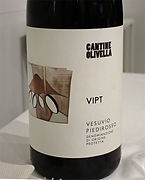
Florian directed the coach driver to Sant'Anastasia, a small town on the volcano's NE periphery. The rain having stopped, we got out to search for the E Curti Ristorante Tipico di Angela Ceriello, where we stayed an unexpected 2 hours. The traditional menu commenced with a large platter of shared starters followed by aubergine & tomato spaghetti, then mutton belly strips, albeit mostly fat. Bottled white and red wines accompanied, the latter the black grape 13% Piedirosso Vesuvio DOC, a lovely rich and fruity red grown in Campania on the flanks of Vesuvius itself. It is as well the wine was so good, as the planned evening wine tasting had been cancelled due to local shops being recently flooded with American wines that had thinned the number of local wines to a dribble.
813j025 PA050213 Piedirosso Vesuvio red wine grown on flanks of Vesuvius.
Herculaneum
Around 15:00 the coach left for Herculaneum, a 12km, 30 minute drive. We were told to meet near the exit at 17:30, leaving us just 2 hours to explore it, 10 minutes of which were needed to walk down and back up to the coach. After the Vesuvius disaster in the morning, now we lost this highlight too.
Aware of this limitation, I went around the site in lightening fashion, managing to cover about two thirds of it, including the skeletons in the fornici (boathouses) at the front bottom, which at the time of the eruption was a beach: about 300 men, women and children sheltered there thinking they were safe, but perished in pyroclastic clouds of ash and toxic gas. Those on show are fibreglass replicas (the external grills enclosing them were added later for the exhibition, and were not originally present).
Below far right is Casa del Rilievo di Telefo (House of the Relief of Telephus), named from a prominent marble relief found inside, depicting the mythological scene of Achilles healing Telephus, son of Hercules.
Left: 813j026 PA050241 Herculaneum sea shore boathouses (fornici) bottom left
Mid L: 813j027 PA060342 boathouses close up
Mid R: 813j028 PA060371 Herculaneum sea shore with Vesuvius in background
Right: 813j029 PA060353 entrance to Casa del Rilievo di Telefo (House of Relief of Telephus)


In various places we came across marble tables with large embedded terracotta vessels called dolia which once held hot soups and stews, heated from below, collectively referred to as a thermopolium:
https://www.archeotravelers.com/en/2020/05/08/thermopolium-the-fast-food-of-the-ancient-romans/
LefT: 813j030 PA060284 thermopolium stew stoves
Mid L: 813j031 PA050279 bread ovens
Mid R: 813j032 PA050262 lararium with Dionysian scenes inside the House of the Skeleton in Insula III.
Right: 813j033 PA060315 rear road of excavated Herculaneum with multiple columns


At 17:45 the coach left for the hotel. As we were due to visit Pompeii the next day I asked if we would see the amphitheatre where Pink Floyd played in 1971, that I'd always wanted to visit. It was just as well I asked because its entrance was at a different location, and Tom kindly agreed to change the plan.
At 19:30 Tom led us out to dinner at Trattoria 'A Pignata (meaning earthenware cooking pot), ~200m away.
Day 4: Monday 06/10/25 Naples
Vesuvius archaeological observatory; VAO (Osservatorio Vesuviano)
Lava deposits
Pompeii
Breakfast was the usual 2 cold boiled eggs and bread but the cake was replaced by a much nicer fruit pie and what appeared to be even nicer home made tiramisu. The sun was back and we sat on the roof terrace.
Osservatorio Vesuviano
Our first stop today was a visit to the archaeological observatory, the first dedicated volcanic observation site in the world, which together with a vast array of minerals and photographs, also houses many original mid to late 1800s bespoke magnetic and seismic detection and transmission instruments:
https://www.parconazionaledelvesuvio.it/en/the-volcano/the-vesuvius-observatory/
Left: 813j034 PA060380 Vesuvius archaeological observatory
Mid L: 813j035 PA060385 VAO director's study
Mid R: 813j036 PA060400 VAO Palmieri Seismograph instrument
Right: 813j037 PA060399 VAO functional description of Palmieri Seismograph


Over the course of an hour we wandered from room to room, each with its own particular range of exhibits, whilst the enthusiastic resident tour guide described their history and operation in the observatory, and even showed us a live seismic recording of our footsteps inside.
813j038 PA060384 from the VAO, the islands of Ischia & Procida on the horizon:
Historical lava field
The observatory is perched on the slopes of Vesuvius (see below), and after the tour we joined hilly woodland walk Trail 9: Il Fiume del Lava (River of Lava), which after about 0.5km led us to a large flank of lava deposited by the 1944 eruption, and a prominent peak panoramic view of the Bay of Naples.

Left: 813j039s map Vesuvius crater, VAO and lava Trail 9 [Scale 200m]
Mid L: 813j040 map PA060435 Lava Trail 9, other lava routes and Herculaneum
Mid R: 813j041 PA060446 Trail 9 lava route head
Right: 813j042 PA060443 Trail 9 lava peak panorama
![813j039s CC map Vesuvius crater, VAO and lava Trail 9 [Scale 200m]](https://static.wixstatic.com/media/d58027_205638cee37a4dec89528c4cae4764b3~mv2.jpg/v1/fill/w_263,h_180,al_c,q_80,usm_0.66_1.00_0.01,enc_avif,quality_auto/813j048s%20CC%20Trail%209%20%26%20observatory%20%26%20Vesuvius%20crater%20%5B100m%5D.jpg)


After the lava field the coach drove 500m down the observatory access road to the Kona restaurant for pizza / tomato pasta, wine from the Vinicola Sannino winery in Herculaneum, and the now familiar Limonchello, before heading off to Pompeii which we reached ~15:00 and where we stayed until 19:00.
Pompeii
As promised, we arrived at the entrance closest to the famous amphitheatre built in 70 BC, which appeared to me much smaller than depicted in the Pink Floyd video. I was expecting to see the stone face masks of comedy and tragedy that were interlaced with the amphitheatre footage but they were absent. Google AI informs me these were instead at the National Archaeological Museum in Naples.
Left: 813j043 PA060468 amphitheatre external staircase and bottom entrance (Vesuvius on horizon)
Mid: 813j044 PA070752 view down rear lower entrance into amphitheatre opposite front lower entrance
Right: 813j045 PA070766 view of rear lower entrance from within the amphitheatre


Left: 813j046 PA060515 fresco Venus in scallop shell with cherubs on dolphins symbolizing love & birth
Mid: 813j047 PA060504 grass covered road with Vesuvius in the background
Right: 813j048 PA070639 mosaic battle between Alexander Great and King Darius of Persia


Left: 813j049 PA070568 column portico at front of Stabian bathbouse adjoining palaestra exercise area
Mid L: 813j050 PA070571 inside the entrance of the Stabian bathhouse
Mid R: 813j051 PA070578 ornate walls within the Stabian bathhouse
Right: 813j052 PA070595 unusual round white public street fountain (lacus)


Left: 813j053 PA070682 Arch of Tiberius (Arch of Germanicus) in central forum
Mid L: 813j054 PA060539 large enclosed bakery with egg timer shaped catillus millstones at rear
Mid R: 813j055 PA070560 Casa di M.Epidio Rufo: 16 volcanic rock columns 4m high with a central fountain
Right: 813j056 PA070775 moon rising over modern Pompeii, from park left just before Amphitheatre Gate


Scroll down 50% for more information on the Casa di Marco Epidio Rufo (House of Epidius Rufos), et al:
https://www.romeartlover.it/Pompeii4.html
After Pompeii the coach carried us to the Voce de Mare (Voice of the Sea) fish restaurant which I think was by the sea near the port of Torre del Greco, and where we again got caught out by the Italian way of delivering restaurant food: simplistically, there is a starter and two main meals. The waiters were unable to adjust to our requests for vegetables to accompany the first main meal, delivering them as the second meal. In my case, I ordered an undressed (I got Tom to explain) tomato salad and I tried to order anchovies but was told they were out, so instead ordered 'beef cube' which I was told is filleted beef, and I specifically stated I wanted chips with it.
As you can guess, a (rather fatty) beef steak arrived by itself and about 40 minutes later a large plate of chips appeared, together with a dressed tomato salad. Long before then I'd given up waiting and accompanied my beef with some of the group sharing starters that Tom had ordered at the very beginning. I wasn't the only one caught out: when my chips appeared so did other meals whose recipients had long given up, and who were now also stuffed: Tom, also full, got his Sea Urchin (roe) Spaghetti and could only manage half, sharing it out, although someone who tried it said it reminded him of a rusty tin can!
We finally got home after 23:00, far later than I would have liked as we had to pack everything tonight because we tomorrow we check out of Hotel Toledo.
Day 5: Tuesday 07/10/25 Naples
Free day; return visit to Vesuvius
City tour with Florian:
Lapis water museum
Overnight ferry to (Stromboli, Salena) Lipari sland
We checked out of our hotel rooms, leaving all luggage in the lounge for later collection.
We had the option today to do as we wished, one suggestion being to visit the Antiquario di Boscoreale (a museum of the daily Roman life, local environment, and agricultural practices in the Vesuvius area before the 79 AD eruption), or revisit Herculaneum, but we chose instead to reclimb Vesuvius in the hope of a better view than Sunday. Although officially his day off, Florian offered a 15:00 afternoon city walking tour to which we also agreed.
Vesuvius (dry)
Tom had arranged for a minibus to take seven of us to a drop-off point to board a bigger public coach for which Florian had bought private tickets on our behalf, to take us back to Vesuvius. When we arrived there was an earlier bus still there, with two spare seats. We agreed with the group that we would take them and the rest would follow in the later coach. We arrived at Vesuvius about 40 minutes later.
This time it was dry and the sun was out and although still a little chilly, probably better for the half hour uphill walk to the summit. It was still a little gusty at the summit, and I'd guess ~14°C.
Left: 813j057 PA070812 crater view looking back towards approach
Mid L: 813j058 PA070806 crater view from approach
Right: 813j059 PA070829 people on far rim opposite


As we looked across the crater we noticed a group of 25 or so people on the higher far side of the rim and wondered how we could get there too. We followed the path a good halfway around the rim but eventually found it cordoned off at a little souvenir shop. We asked a guide if we could pass, but he said it was only open to pre-approved scientific expeditions or cultural exchange students, who were the people we saw.

We stayed on the summit about an hour, watching smoking fumeroles dotted around inside, and admiring the vast external panorama.
Video to right
812m03 PA070828 + PA070809 + PA070844 Vesuvius summit fumeroles
Photos below
Left: 813j060 PA070834 view S towards the Sorrento Peninsula
Mid: 813j061 PA070823 approximate location of Herculaneum
Right: 813j062s map location of Herculaneum [scale 200m]


![813j062s map location of Herculaneum [scale 200m]](https://static.wixstatic.com/media/d58027_8e86a96b645c4fcdbc719ac6b21c3439~mv2.jpg/v1/fill/w_239,h_179,al_c,q_80,usm_0.66_1.00_0.01,enc_avif,quality_auto/813j0xs%20CC%20Herculaneum%20on%20map%20%5B200m%5D.jpg)
As we were about to leave we bumped into our fellow companions who had now also arrived, then we descended to the car park to catch the yellow public bus which took us to the unremarkable Ercolano Scavi (Herculaneum Excavations) railway station.
L: 813j063 PA070851 ticket to Naples Garibaldi
R: 813j064 PA070849 Ercolano Scavi station
We paid €2.60 for a multistop 20 minute train to Naples Garibaldi central station, where we descended and caught the Line 1 metro underground train to the Toldeo stop whose stairs emerge just where Via Montecalvano leads up to hotel Toledo.
We arrived around 15:10 but thankfully Florian was still waiting for us.


Naples cultural tour
Florian took us on a small circular walk of about 2km, south east of our hotel; first to an interior courtyard with Baroque art on its high ceiling entrance, then across Piazza Dante to a building with a grand frontage enscribed Convitto Nazionale Vittorio Emanuele II on its clock tower in honour of Italy's first king. Designed by Luigi Vanvitelli and known for its grand architecture, the building is an historic educational complex that although from a later era, is similar in nature to the establishments the original Grand Tour would have embraced.
Not far from this we reached Piazza Bellini, where exposed ruins below are remnants of the ancient western defensive walls (Mura Greche) of the Greek city of Neapolis, dating back to the 4th century BC.
Finally, we came to the Basilica di Santa Maria Maggiore in Piazzetta Pietrasanta, which houses the LAPIS Museum (Lapis is latin for stone). Inside, we descended a spiral metal staircase some 100m to explore a vast system of underground water filled cisterns feeding many ornate fountains constructed as status symbols across many districts in the ancient Greek era, when flowing water portrayed wealth.
Left: 813j065 PA070864 Convitto Nazionale Vittorio Emanuele II on Piazza Dante
Mid L: 813j066 PA070867 defensive walls from Greek city of Neapolis
Mid R: 813j067 PA070871 side view of Basilica di Santa Maria Maggiore
Right: 813j068 PA070900 00m28s water filled cistern under Basilicia


Back at the hotel we gathered our luggage and brought it down to the street for the journey to the harbour to join the ferry. We had the second taxi and the driver grudgingly loaded bags for 7 of us into his people carrier, all the while shouting angrily into his mobile. This persisted for the entire journey to the harbour, accompanied by frantic gesticulations and single handled steering. Tom later explained the driver was angry carrying so many people and luggage, and had been demanding more money!
By 20:00 we were in a long single line queue at the harbour, each having our passports checked before boarding the large Siremar Laurana overnight ferry to Lipari.
We left our luggage in our cabin and ascended the stairs to the top external deck sandwiched between two smelly diesel stacks, and watched as the ferry left Naples around 21:00 accompanied by white seabirds silhouetted in the dark sky. As Naples disappeared, we retired to our cabin for an early night. I was delighted to find the simple bunk bed long enough for my 6'4" frame, and infinitely more comfortable than the one at Hotel Toledo.
813m04 PA080941+52+53 ferry leaving Naples & seagulls following
Day 6: Wednesday 08/10/25 Lipardi
Stromboli, Panarea, Salina
Lipari Marina Lunga harbour
Hike to pumice & obsidian deposits
Tom had suggested we look out around 05:30 for the Stromboli volcano, known as the Lighthouse of the Tyrrhenian sea due to its near contant fiery red eruptions but there was nothing visible this morning. The ferry docked there for a short period then continued to Panarea, then Salina, docking at Santa Marina on the east coast at 07:00.
813j069 PA080959 Naples ferry leaving Salina
813j070s Aeolian islands: all Grand Tour boat routes [15km]

![813j070s CC map Aeolian islands all Grand Tour boat routes [15km].jpg](https://static.wixstatic.com/media/d58027_919909598ee2465992de7675a556a937~mv2.jpg/v1/fill/w_116,h_180,al_c,q_80,usm_0.66_1.00_0.01,enc_avif,quality_auto/813j68s%20CC%20Aeolian%20islands%20all%20Grand%20Tour%20boat%20routes%20%5B15km%5D.jpg)
Panarea is active but dormant, and is part of the Stromboli volcanic system. Salina is the remnants of six extinct volcanoes; the island's ancient Greek name Didyme (twins) refers to its two most prominent and well-preserved volcanic cones, Monte dei Porri and Monte Fossa delle Felci (see map above).
My partner saw Stromboli but I slept through until rude banging on all cabin doors at 08:30 evicted us earlier than expected. When we emerged we discovered we were just leaving Salina.
Now hungry, we looked for breakfast but all there seemed to be was coffee and strange orange egg shaped balls of rice and cheese deep fried in a breadcrumb shell: Sicilian street food called arancini, the name meaning 'little oranges', derived from its shape and colour. At the time I thought it might be a scotch egg and was surprised when they microwaved it, and I have to say I would have preferred it cold.
We also found croissants with choices of chocolate and what tasted like custard with a fruit essence.
Lipari
As we approached Lipari from the east, we passed the scarred hillside where pumice quarried since the 1500s has only recently ceased. Further on, the ferry docked at the Marina Lunga port, Lipari castle appearing amidst the ancient citadel on its rocky pedestal just west of the port, its fortifications stemming largely from the 1800s, but with significant Greek, Roman and Normandy archeological artifacts.
Left: 813j071 PA080970 pumice quarry scars on Lipari eastern hillside
L Mid: 813j072 PA080985 Lipari citadel & castle
R mid: 813j073 PA081003 one of many narrow labyrinths between houses
R MID: 813j074 PA080994 Marina Corta small harbour, east Lipari


By 10:20 our two taxis had laboured a short way up the hilly interior and dropped us off at hotel Tritone, an elegant modern design with bright and spacous bedrooms surrounded by a garden on the ground floor below the main dining room. Again no twin bed, but what appeared to be a large and comfortable queen, if not king. We showered, changed, and with the aid of the island road map provided by reception, headed out to the nearby 'supermarket' for a better breakfast. There were no ready made sandwiches but they made us delicious bespoke salad rolls.
We strolled down the narrow roads and thin alleyways between the houses and ate them in the small picturesque Marina Corta harbour.
Right: 813j075 P1150032 Lipari street map from hotel reception

Another hot sunny day; at midday I measured 25°C with 52% humidity, my UV meter warning level 7/9: a maximum exposure time for bare skin of just 15 minutes, but we were already covered in SPF50.
Left: 813j076s map Liparia obsidian outcrop & islands: Vulcano, Salina, Panarea, Stromboli [scale 5km]
Right: 813j077s map Lipari Portichello and Acquacalda beach near our northern island walk [scale 1km]
Porticello obsidian
![813j076s CC Lipari Portichello obsidian & Paneaa & Stromboli map [5km].jpg](https://static.wixstatic.com/media/d58027_f51008114cd04ba4b68e706bdf058b58~mv2.jpg/v1/fill/w_126,h_180,al_c,q_80,usm_0.66_1.00_0.01,enc_avif,quality_auto/813j075s%20CC%20Lipari%20Portichello%20obsidian%20%26%20Paneaa%20%26%20Stromboli%20map%20%5B5km%5D.jpg)
After another roll for lunch, two taxis ferried us around Marina Lunga to an area near Portichello on the far northern peninsular, where a rich deposit of volcanic obsidian exists. We disembarked and made our way up a dusty track littered in places with small shards of sharp, black glasslike obsidian, until finally we reached a panoramic viewpoint flanked by the pumice hilltop quarry workings to the south, and distant sea views of the islands of Panarea at 15km and Stromboli at 36km to the north east.
Here Tom explained the pumice industry and the island's volcanic origins while we tasted a strange round fruit on what Tom identified as a strawberry tree, Arbutus unedo. Tom said after about 100k years, obsidian changes to a white rock like pumice
![813j077s CC Lipari map showing Porticello & Acquacalda [1 km].jpg](https://static.wixstatic.com/media/d58027_e5d68d480615413f813df9400e9bcf11~mv2.jpg/v1/fill/w_126,h_180,al_c,q_80,usm_0.66_1.00_0.01,enc_avif,quality_auto/813j076s%20CC%20Lipari%20map%20showing%20Porticello%20%26%20Acquacalda%20%5B1%20km%5D.jpg)
Acquacalda
About an hour later we made our way downhill, but we were further north than Tom intended and now we had a westward view down to the beach at Acquacalda, and further west across the sea to Salina. Tom navigated us back south across the headland, down a steep rocky path until we reached the SP180 road. Here we passed several lava outcrops stopped in their tracks, exposing their weaving patterns of once molten rock. We crossed the road to inspect a split cliff face of pumice above the sea, then walked down to the far northern tip of Porticello beach to a clearing on the old pumice industrial complex. After a quick stroll on the beach where a large lava block is also present, taxis took us back to our hotel.
Lava outcrops
Left: 813j078 PA081046 Salina viewed from Porticello & its beach
Mid L: 813j079 PA091051 wavy lava outcrop near road
Mid R: 813j080 PA091060 pumice quarry at Porticello
Right: 813j081 PA091079 lava block on pumice works beach


At 19:45 we met Tom in the foyer and he led us down into the town to the L'Anfora (The Amphora) restaurant which was hidden at the end of a narrow alleyway. As before we enjoyed a large shared starter: stuffed anchovies, sliced plum tomatoes, potatoes, raw smoked swordfish, egg plant, corgette slices, pumpkin flowers stuffed with ricotta cheese, tempura prawns, and white and a particularly strong red wine. The main meal included a curry, two types of fish ravioli and vegetarian pasta swirls, and was followed by dessert of choice and a small glass of sherry in place of the usual Limoncello.
Day 7: Thursday 09/10/25 Lipardi / Vulcano
Lipari archeological museum
Vulcano island
Despite an excellent comfortable bed, I woke freezing at 05:00, unaware the previous occupant had set the room A/C to automatically cool the room on a timer that wasn't running when we retired around 23:00. Now awake, I found my earplugs could not block out its sound but at the time I assumed it was some external disturbance and not the A/C. My partner didn't notice as she likes it cool but I could not get back to proper sleep. The worst was yet to come: at 07:00 we were abruptly jolted awake by countless chairs loudly scraping across the floor of the restaurant immediately above all the bedrooms on the Ground floor. You would have thought they would have noticed this and put rubber bungs on their legs...
Today's plan was a morning visit to the renowned archeological museum in the citadel, and an afternoon trip to Vulcano island to climb its volcano which was named after Vulcan, the Roman god of fire and is the actual origin of the word volcano. Largely due to lack of sleep I opted out of the museum visit as I didn't fancy trudging all the way up to the citadel and back down again in 30°C, but I did want to climb the volcano, so I enjoyed a nice breakfast of scrambled eggs, bacon and apricot pie and a surprisingly good gateaux, and spent the morning relaxing. I arranged to meet Tom and the group down in the small harbour at 12:00 for the day trip to Vulcano in our hire boat 'Sbocciata' (Blossomed).
Left: 813j082 PA080999 road down to Marina Corta harbour bridge
Mid L: 813j083 PA091093 00m05s Sbocciata boat about to leave Marina Corta harbour
Mid R: 813j084 PA091122 boat to Vulcano volcanic rocks in sea
Right: 813j085 PA091177 Vulcano volcano from Porto di Levante harbour
Vulcano


Sbocciata left the harbour and stopped to view some volcanic sea stacks before carrying on to Vulcano. We disembarked at Porto di Levante on the eastern side of the island and walked to the nearest beach, where Tom invited us to throw loose pumice on the shore into the sea, where it floated. Further inland we came to white mud pools which were open for bathing until 2020, when the temperature and hydrogen sulphide gas levels both increased above safe levels. Hot and sunny, I measured 31.2°C and 33% humidity.
Next there was the opportunity to swim in the sea for an hour on the beach north of the jetty, or explore more on foot. We chose the sea, where we found a volcanic gas vent bubbling up not far from the shore; swimmers were told to avoid it but the gas intensity was minimal and the water no hotter than a jacuzzi, which most visitors used it for, as there was a small sand bank below it.
Approaching midday we followed the road south past the jetty, and just as it turned north towards Vulcano, we found the others in the Planeta restaurant on the corner, and sat down for a salad. At 15:48 we left, walking about 2km north until we came to the entrance to Vulcano on the left. Here a CCTV-monitored red traffic light prohibits ascent between 12:00 and 16:00 to avoid sunstroke; the light is also used when gas emission levels are too high. We set off at 16:00 and it took us about 30 minutes.
Left: 813j086s map Vulcano island [Scale 1km]
Mid L: 813j087 PA091182 00m02s thrown pumice floating in the sea
Mid R: 813j088 PA091208 white mud baths [closed since 2020]
Right: 813j089 PA091187 volcanic gas jacuzzi in the sea
Pumice & mud pools
![813j086s CC Vulcano island map [Scale 1km]](https://static.wixstatic.com/media/d58027_f9ef8fa417b34d6a94eba4416016dd6d~mv2.jpg/v1/fill/w_148,h_180,al_c,q_80,usm_0.66_1.00_0.01,enc_avif,quality_auto/813joxs%20CC%20Vulcano%20island%20map%20%5B1km%5D.jpg)

![813j088 PA091208 white mud baths [closed since 2020]](https://static.wixstatic.com/media/d58027_0df5c5aa1b7f4d84b5f044fff188b1bf~mv2.jpg/v1/fill/w_313,h_180,al_c,q_80,usm_0.66_1.00_0.01,enc_avif,quality_auto/d58027_0df5c5aa1b7f4d84b5f044fff188b1bf~mv2.jpg)

Vulcano ascent
The ascent is relatively easy, the terrain changing from sandy grassland to sandy lava rock, then a pink hue due to oxidisation of hot volcanic gases rich in sulphur and iron interacting with air and water. Here the path is wide, becoming rocky then deeply furrowed and finally darkened by loose volcanic gravel approaching the summit. Inside, the huge crater is referred to as La Fossa (The Pit).
Left: 813j090 PA091213 red traffic light stops ascents during hot midday sun
Mid: 813j091 PA091256 pink rock track top end
Right: 813j092 PA091272 lower summit view north of peak (the dot top far right is a person)


We walked north around the east rim to the summit which was opposite the point where we ascended, then I noticed a path around the western rim (PA101323) which I followed. Initially it headed towards the central fumeroles where entry is forbidden but then veered west to skim the rim there, passing close to the mud-filled 'moon lake'. Halfway down I realised I'd forgotten the boat was leaving at 18:00 and it was now 17:38! It was difficult to go faster on the zig zags which were there to help with the steep descent, but as they lengthened I was able to go faster and even ran up some uphill sections on the plain below near the moon lake, which is the dark spot on the far left of the crater rim in sign photo PA091215 below left. Embarrasingly, Tom and the others were waiting anxiously for me halfway down, but I made good time and was only about 10 minutes late, and the boat eventually left ~18:30 anyway, leaving time for a beer. A pretty, orangey red sunset fell over us as Sbocciata made its way back to Lipari.
Left: 813j093 PA091215 route up and around Vulcano [scale 200m]
Mid L: 813m05 PA091280 summit smoking fumaroles & view north to Lipari
Mid R: 813j094 PA101311 fumeroles viewed from the summit
Right: 813j095 PA101323 summit view of Lipari & my western rim return route (S is at the top)
![813j093 PA091215 route up and around Vulcano [scale 200m]](https://static.wixstatic.com/media/d58027_cb48d46b4cd346c89d68558b513a0e43~mv2.jpg/v1/fill/w_162,h_180,al_c,q_80,usm_0.66_1.00_0.01,enc_avif,quality_auto/813j0x%20PA091215%20route%20up%20and%20around%20Vulcano%20%5B200m%5D.jpg)


After a shower and a change, Tom walked us down to the citadel area where we had dinner at the upmarket Filippino fish restaurant. Another great group starter with tasty meatballs in tomato sauce, olives, ratatouille, prawns with oranges, octopus, red tinted bread, followed by a rich bean soup for the main course, then sweet: my pistachio ice cream tasted nothing like it but other sweets were much better.
Day 8: Friday 10/10/25 Stromboli
Boat trip from Lipardi
Solfatara Lisca Bianca sulphurous rock islands
Porto di Stromboli
290m Sciara del Fuoco eruption viewpoint
We were inevitably again woken at 07:30 by scraping chair legs, but this time the A/C was off and we had a good night's sleep, and breakfast was as good as the first day. We checked out at 10:00 and taxis took us down to the little Marina Corta harbour for our transfer to Stromboli island on a small hire boat named 'Infinity', which took about 2 hours. There was room for four people to sit on its roof, which was a little chilly in the sea breeze but much more fun, and afforded a grand view of the horizon.
![813j096s CC Stromboli street map [200m].jpg](https://static.wixstatic.com/media/d58027_b7d34dbe12bb490c9660b1385082e356~mv2.jpg/v1/fill/w_265,h_180,al_c,q_80,usm_0.66_1.00_0.01,enc_avif,quality_auto/813j095s%20CC%20Stromboli%20street%20map%20%5B200m%5D.jpg)
813j096s Stromboli street map [200m] (Porto di Stromboli, Pizza restaurant, hotel Villagio, Viewpoints)
Sulphur rock islands
Halfway there and about 2km east of Panarea, the boat slowed to view Solfatara Lisca Bianca (Sulphurous White Rock), a small collection of volcanic outcrops in the sea where sulphur can be seen on the rocks and sulphurous gas bubbles to the surface, the smell lingering in the air. An hour later we docked on the east coast at Porto di Stromboli, the main harbour. Taxis took our main baggage and we walked the ~1.6km to our hotal Villagio, see map above.
left: 813j097 PA101434 solfatara Lisca Bianca (left) & Le Guglie (Pinnacles) 1.5km off Panarea (rear)
Mid L: 813j098 PA101469 approaching Stromboli
Mid R: 813j099 PA101496 Infinity boat offloading our luggage at Porto di Stromboli
Right: 813j100 PA111618 beach from hotel & Strombolicchio island


Stromboli
Villagio is a lovely hotel perched on the clifftop with fantastic views out to sea, and even a small dark volcanic sandy beach to the south east.
At 14:00 a simple lunch was provided in the hotel restaurant, which had a beautiful panoramic sea view above our rooms: straight pasta with tomato sauce, olives, capers, Parmesan cheese, bread and wine.
290m viewpoint
We relaxed for an hour, then at 16:30 Tom guided us along the 1.5km walk to the eruption viewpoint identified on the link above as Punto Panoramico (Panoramic Viewpoint) 290m up the Sciara del Fuoco (Stream of Fire), a large steep blackened slope (talus scree) on the northwest side of the volcano where lava flows, hot rocks and ash cascade down into the sea. There were two groups; we opted for Tom's, which took a steep uphill shortcut bypassing the normal route that follows a long shallow zigzagging paved path, see map and link.
For those who have access to Researchgate, a particularly good 3D representation can be found HERE.
(I have access, but it may not be in the public domain - try it!)
Once at the viewpoint, we squeezed between other spectators and like them, perched 0.5m from the vertical drop to the escarpment below, which Deepseek estimates could be 30-50m. I gingerly set up the cheap lightweight Slik 5000 tripod I'd brought, constantly gripping it and the expensive Olympus TG-7 pocket camera on it that I'd bought for the trip, wildly aware I could inadvertently and very easily knock them both down the ravine. We sat there watching for signs of activity as dusk fell and around 19:00 it got dark, and noticibly colder due to a gusty wind.
Most other people left but we stayed, puzzled why they were abandoning the best viewing time, but there were few eruptions, which Tom explained are molten rock being thrown upwards by pockets of volcanic gas. The incandescent eruptions are typically lava, lapilli ('little stones': 2-64mm volcanic fragments) and ash, in our case mostly ejected about 20m, but can be up to a few hundred metres.
813j101 PA111567 overcrowded 290m viewpoint
813j102 PA111578 near sunset over sea from flank at 290m
813j103 PA111590 aftermath of a missed eruption
813j104 PA111607 the only eruption photo I got


It was difficult to capture them on the TG-7 which I found had poorer low light sensitivity than a (admittedly expensive) mobile. Eruptions were random, up to 20 minutes apart and I'd forgotten to bring a spare battery, so I couldn't record video for long. I missed most of the few eruptions that appeared, often due to too slow a reaction to click the shutter, but also from slow autofocus due to low light. Perhaps the mobiles had a live pre-shot buffer that captured a few frames before each button press?
We left at 20:00 and Tom guided us down onto Via Vittorio Emanuele (see map link), the main arterial road off which we entered the La Lampara pizza restaurant (The Lamp: probably meaning Stromboli). I'd finished my last Lipardi roll on Stromboli, so I just had a 'Tartufo Nero' (Black Truffle) chocolate ice cream instead. A full day, and bed finally around midnight.
Day 9: Saturday 11/10/25 Stromboli
Stromboli
400m Sciara del Fuoco eruption viewpoint
Breakfast was back down to basics: chocolate croissants, lemon cake, Melba toast and raw eggs to boil in hot water, although someone from another group ran off with my first two when I left them to cook!
The previous night a catamaran appeared in the sea opposite our room and this morning a swimmer from it appeared too. Hot and sunny, at 11am I measured 36°C in the sun, 30°C in the shade and 33% humidity. My partner enjoyed a quick swim at the nearby beach (see above).
At 12:00 we all met at the Chiesa di San Vincenzo (Church of St. Vincent) plaza and signed a disclaimer for climbing Stromboli to the 400m viewpoint which requires the company of a certified guide, and Tom gave everyone a climbing helmet. Then we walked 100m to Ristorante Luciano, perched on a high viewpoint with a stunning wide view across the ocean.
Tom told us the closer we got to Sicily the better the pizzas would be. Noticing a press article at the entrance praising the chef, I thought this would be the start of that and ordered a Diavola pizza with piquant sausage, but there was very little on it and I found it bland and not at all spicy. Only after I added olives, tomatoes and raw onions from my partner's salad did it begin to perk up. However the overly generous helping of tiramisu made up for it, having a lovely gateaux sponge albeit again fairly tasteless, but very little alcohol, which I prefer.
813j105 PA111632 view from Ristorante Luciano
400m viewpoint

At 16:30 we started back to the 290m viewpoint where we met our widely knowledgeable guide Renzo Zaia from Magmatrek who took great care to ensure we all arrived safely at the 400m viewpoint.
Left: 813j106 PA111566 start of a shortcut to 290m viewpoint
Mid L: 813j107 PA121661 fenced ascent start to 400m viewpoint
Mid: 813j108 PA121664 now led by mountain guide Renzo Zaia
Mid R: 813j109 PA121680 far above the 290m public viewpoint
Right: 813j110 PA121674 one of many more steep ascents


The ascent to the 290m point was largely a wide paved long zigzagging path with an outer protective wall (most shortcuts were much steeper single person tracks between its levels). A wooden fence extended above this but soon ended, the path narrowing to a single meandering track, often steep and narrow. It felt like we were mountain goats traversing thin grassy knolls projecting out towards the sea with a worrying drop. Where it was especially steep and side rocks protruded, I gripped them to steady myself. A little after a small geological transmitter aerial appeared, we reached the narrow 400m viewpoint where we sat down, got out our cameras, in some cases drank wine, and waited for Stromboli to impress. Here Deepseek estimates the vertical drop in front of us to the escarpment below could be 50 to 80m.
After the previous night I gave up trying to photograph eruptions and instead just took video, but once again there were very long periods when nothing happened and although I now had a spare battery, I instead found myself trying to preserve video memory with similar disastrous results but eventually we all managed to capture a little live footage.
Left: 813j111 PA121685 the view at 400m
Mid L: 812m06 PA121742 gas 2 bursts
Mid R: 812m07 PA121704 PA121750 PA121755 gas bursts dusk 1 dark 2

By 20:30 we had grown despondent from the scarcity of eruptions and agreed to descend, donning our helmets. Renzo proved invaluable when he kindly lent me his stick. At 6'5" in mountaineering boots, I found the final steep ascent daunting and I wasn't the only one dreading its descent but it was easier than I expected as my headtorch focused at my feet made it too dark to see the drop. It was still scary knowing what was there and I could not help tensing my leg muscles, concentrating hard to avoid a slip.
Typically, as soon as we were on our way down Stromboli decided to entertain us again, but it was too late. Renzo walked very slowly throughout, which was fine on the ascent, but a little annoying as we reached town because my feet were sore and I wanted to finish quickly, but he followed a different route I didn't recognise. Eventually we ended up at the La Lampara Pizza restaurant again, which Tom had earlier been dangling as the final stop for the night.
Day 10: Sunday 12/10/25 Stromboli
Boat tour around Stromboli island
Ginostra harbour and viewpoints
Stromboli viewpoints
Strombolicchio island lighthouse
Lunch with locals & Jam test
Ginostra flank view
Breakfast was at 08:30, then we all walked to the Porto di Stromboli harbour to board an inflatable speed boat for our tour around Stromboli. I made sure we sat at the front because I fully expected a drenching if we hit troughs, but my fears were largely unfounded. The boat traversed the length of the island before we disembarked in the tiny Ginostra harbour at the opposite end on the west coast. Another glorious hot sunny day, I measured 32°C / 37%.
We walked up its steep concrete ramp to a viewpoint over the harbour and then traced a sometimes steep, undulating path made from volcanic rocks, through widely spaced properties straddling the craggy volcanic slope. Eventually after about a half hour we reached a remote colour camera pointed at the volcano, on the west shore clifftop, part of an early warning system transmitting via a radio attennae visible on the hill behind. Here Tom pointed to the deep furrow at the rear of the flank, where the 290m and 400m Sciara del Fuoco eruption viewpoints now faced us from the opposite direction. Below, a turquoise sea lathered its foam across picturesque volcanic rocks.
Left: 813j112 PA121796 Ginostra harbour from viewpoint
Mid L: 813j113 PA121799 volcanic rock paths connect all buildings
Mid: 813j114 PA121831 camera watching volcano (PA121844 antennae inset below)
Mid R: 813j115 PA121833 flank with estimated 290m & 400m viewpoints
Right: 813j116 PA121843 turquoise sea and rocks below camera cliff
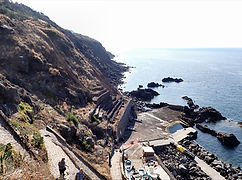


We returned to the boat which continued around the island until just offshore from our hotel, when it turned outward ~2km to circle the Strombolicchio lighthouse that sits atop a 50m remnant of the core of an ancient volcano. A rusty metal staircase leads up to the automated lighthouse and at its base we found a swimmer who clambered on board, clearly planned as he retrieved a bag of clothes from the boat, which then returned to Porto di Stromboli.
Left: 813j117 PA121856 our boat in Ginostra harbour
Right: 813j118 PA121912 Strombolicchio island lighthouse


Tom led us through Stromboli's narrow winding streets to one of his friend's houses where, on an outside patio 14 places had been laid across two tables on a pretty blue tablecloth that matched the house.
Left: 813j119 PA121935 home brewed liqueurs Rosello, Rucolia Celloo, Alorello
Mid: 813j120 PA121936 Nucillo 'e Curti Cru Vesuvio walnut liqueur
Right: 813j121 PA121949 alternative shore route to the hotel
Jam tasting


It now being 13:30 and Sunday lunchtime, even here we received a huge antipasto starter, followed by a spaghetti bolognaise main course accompanied by homebrewed champagne and wines, obscure homemade jams, and equally strange homebrewed liqueurs (Rosello, Rucolia Celloo, Alorello) and a bottle of Nucillo 'e Curti Cru Vesuvio (walnut liqueur, 51.7%).

As the liquer tasting became more raucus someone donned a blindfold and guessed most of the Jams with surprising accuracy. It was quite some time later when we expressed our grateful farewells, a few of us returning to the hotel via the shore route for a change.
My partner went back to the 290m viewpoint to try for more footage while I packed, then went to the La Lampara pizza restaurant for dinner by myself as it was the nearest eatery to the hotel, which did not provide dinner. As I was leaving I spotted half of our companions in the hotel lounge glued to the TV watching the black and white 1950 Italian drama Stromboli (Land of God) starring Ingrid Bergman, filmed on the island. This time I chose a mushroom pizza, but it was still pretty tasteless, my instructions 'con olive' were ignored: no olives came on it, and I suspect they used tinned mushrooms but I did enjoy another Tartufo Nero chocolate ice cream.
Day 11: Monday 13/10/25 Etna
Hydrofoil island hop to Milazzi
Etna hotel
This morning we were up at 07:30 because today we leave the island. At 08:00 a frustrated water tanker newly anchored just a few hundred metres away gave 5 loud blasts on its horn because no-one had appeared to connect its water pipes to the island. The hydrofoil takes 2.5 hours to reach Milazzo.
Everyone made their way to the harbour and I chose an electric taxi. Stops: Stromboli 11:30
We boarded the Alessandro Morace hydrofoil which left at 11:00. Panarea 12:00
Selina 12:15
813m08 PA131954 electric taxi to harbour & driver Dachshund (& water tanker) Lipari 12:45
813j122 PA131961 Alessandro Morace hydrofoil at Stromboli Vulcano 13:09
813j123 PA131994 return hydrofoil through our dirty porthole Milazzo 14:06


Milazzi
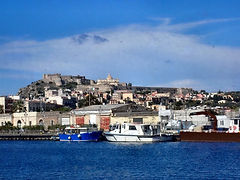
Immediately visible in Milazzi harbour is the massive ~14km square Castello di Milazzo citadel which started off as a defensive site in the 4000 BC Neolithic period and was thereafter continually enhanced: the Normans built the castle and further modifications and enlargements progressed across the Medieval and Early Modern periods. Unfortunately we could only marvel at it from a distance:
https://en.wikipedia.org/wiki/Castello_di_Milazzo
We had a 40 minute wait and went off looking for food, bringing back more DIY rolls from a nearby shop and a huge chocolate bomb cake that cost €5 but was one of the best I've ever eaten: about 100mm round and with chocolate mousse then gateaux sponge then a filled choux bun in a delicate crunchy shell.
For two days now Tom has been warning everyone the accomodation at Etna will be very rustic, everyone will be in bunk beds and we will all have to use a shared bathroom.
A minibus picked us up at 15:20 and we arrived at La Sapienza Nicolosi Etna hotel at 17:30, at an elevation of 1920m where I measured 7°C with surprisingy low 35% humidity.
813j124 PA131998 Castello di Milazzo citadel above harbour
813j125s Bar pasticceria DiamonD 44 Via Giorgio Rizzo Milazzo & cake
812j126 PA142025 Etna chairlift seen from hotel on arrival


The hotel turned out to be luxurious and on discovering a mini spa included in the price, my partner and I took the first slot even though we only had 30 minutes because Tom wanted everyone in the hotel bar to try pistachio liqueur, Fuoco dell'Etna (Fire of Etna) scarlet-red strawberry 70% liqueur and a white wine spritzer mixed with it, while a short documentary of Etna ran on the bar TV screen. Then we all walked downhill about 0.5km to Ristorante di Rifugio Sapienza for dinner, in my case a Nord Est porchini muscadone spicy caliceddi sausage and chilli oil pizza which was at long last loaded and full of flavour.
Day 12: Tuesday 14/10/25 Etna
Etna ascent
07:30, a great breakfast: scrambled eggs, bacon, chicken, mushrooms, tomatoes, bread and cake.
We left early at 8:30 due to the original route being destroyed by the last lava flow in February 2025 and instead of ascending in the south, our coach had to drive us to the north to climb there. Furthermore Etna's central crater was closed due to heightened volcanic activity so we would be climbing the Nord Est crater instead. Tom pointed out numerous outcrops of lava across the truly massive area Etna encompasses.
Bumpy ride to 3011m
The coach took us to a car park at an elevation of 1688m [TG-7 camera] where we were kitted out with climbing helmets, met our guide Francesco and clambored into a smaller, more rugged bus.
This took us up higher on a rough track hewn by bulldozer, the vehicle lurching wildy in all directions as we repeatedly hit deep ruts, reminding me of an infamous UK TV video of a group of young boy scouts trying to eat burgers and milkshakes on a rollercoaster. I expect they replace the axles on a regular basis. Eventually the track ended at an elevation of 3011m [TG-7], time 10:40.
Right: 813m09 PA142066 the hilarious bumpy bus ride up to 3011m
Central meeting area
We emerged to climb up a visible zigzag path in loose shingle to a central meeting area at 3190m [TG-7] behind a solar powered sensor antenna on a small hill, and watched a tourist helicopter flying below us.
Left: 813j127 PA142080 ascent to central area starting from the bus park at 3011m
Mid L: 813j128 PA142101 seismology antenna on small hill & buses parked on the right far below
Mid: 813j129 PA142103 climbers ascending Nord Est viewed from central meeting point antenna hill
Mid R: 813j130 PA142093 ascent to Bocca Nuova fumeroles peak
Right: 813j131 PA142098 helicopter flying below us


Bocca Nuova fumeroles
After a short break at the central meeting point, we ascended an increasingly rock-filled craggy path to Bocca Nuova (New Mouth) peak formed in 1911, where we observed vigorous fumerole steam and gas activity.
Left: 813m10 PA142127 Bocca Nuova outermost fumeroles steaming
Mid: 813j132 PA142132 Bocca Nuova steam & gas fumeroles
Right: 813m11 PA142145 guide speaks by fumeroles & view of peak steaming above

Nord Est crater ascent
We retraced our steps to the central area and headed in the opposite direction to climb the Nord Est crater ~680m NE of Bocca Nuova. The penultimate ascent was an exposed icy and in places slippery face where we were buffeted by a cold wind and I measured an ambient of 1.8°C, followed by a steep 50m incline to the top, first waiting for others to descend the shared path. Once on the 3296m [TG-7] summit, I measured a warmer 6.6°C and unsurprisingly my UV meter maxed out at 9/9. Vast white clouds of steam and hydrogen sulphide gas periodically choked us with a dry acidic hit to the back of the throat.
Gusts of wind swirled the gas around us, hiding the inside from our view with no more than a fleeting glimpse of a short section of its rim. Our guide said the rim was ~200m across & ~100m deep to a pool of magma. We waited ~15 minutes hoping the gas would clear but instead it came towards us and we descended.
When we reached the central area and paused for lunch, a kind guide handed out little cups of spritzer.
Left: 813j133 PA142171 another group descending from Nord Est crater
Mid L: 813m12 PA142177 Nord Est 3296m [TG-7] summit gas & steam
Mid R: 813j134 PA142195 summit view to NE of buried observatory & flat ash plain below
Right: 813j135 PA142207 guide gives out Vini di Batola spritzer in central meeting area


GPS coordinates
The red blob on the maps below are the GPS co-ordinates from my Olympus TG-7 camera, showing our location. The camera also provided the altitude based on pressure:
Left: 813j136s 37°45'06"N 14°59'29"E #2126 3298m (687hPa) Bocca Nuova crater [100m] (where we went 1st)
Mid L: 813j137s 37°45'07"N 14°59'33"E #2159 3241m (685hPa) Bocca Nuova fumeroles [100m]
Mid R: 813j138s 37°45'22"N 14°59'48"E #2181 3296m (680hPa) Nord Est summit [100m](steamy crater on left)
Right: 813j139s 37°45'29"N 14°59'39"E #2208 3186m (691hPa) central meeting area [100m] (our lunch area)
![813j136s CC 37°45'06N 14°59'29E #2126 3298m (687hPa) Bocca Nuova crater [100m].jpg](https://static.wixstatic.com/media/d58027_6a3e7b60347f4d429be907ab91d5dc8b~mv2.jpg/v1/fill/w_167,h_171,al_c,q_80,usm_0.66_1.00_0.01,enc_avif,quality_auto/813j137s%20CC%2037%C2%B045'06N%2014%C2%B059'29E%20%232126%203298m%20(687hPa)%20Bocca%20Nuova%20crater%20%5B100m%5D.jpg)
![813j137s CC 37°45'07N 14°59'33E #2159 3241m (685hPa) Bocca Nuova fumeroles [100m].jpg](https://static.wixstatic.com/media/d58027_32ec69588b4245f5a6527bec83cc1c57~mv2.jpg/v1/fill/w_175,h_180,al_c,q_80,usm_0.66_1.00_0.01,enc_avif,quality_auto/813j138s%20CC%2037%C2%B045'07N%2014%C2%B059'33E%20%232159%203241m%20(685hPa)%20Bocca%20Nuova%20fumeroles%20%5B100m%5D.jpg)
![813j138s CC 37°45'22N 14°59'48E #2181 3296m (680hPa) Nord Est summit [100m].jpg](https://static.wixstatic.com/media/d58027_0c53687176eb4724b9a0ec71cbfa4f23~mv2.jpg/v1/fill/w_175,h_180,al_c,q_80,usm_0.66_1.00_0.01,enc_avif,quality_auto/813j139s%20CC%2037%C2%B045'22N%2014%C2%B059'48E%20%232181%203296m%20(680hPa)%20Nord%20Est%20summit%20%5B100m%5D.jpg)
![813j139s CC 37°45'29N 14°59'39E #2208 3186m (691hPa) central meeting area [100m].jpg](https://static.wixstatic.com/media/d58027_0eb777653d7d4b0db7bedd1d9cfb8eb3~mv2.jpg/v1/fill/w_175,h_180,al_c,q_80,usm_0.66_1.00_0.01,enc_avif,quality_auto/813j140s%20CC%2037%C2%B045'29N%2014%C2%B059'39E%20%232208%203186m%20(691hPa)%20central%20meeting%20area%20%5B100m%5D.jpg)
Descent & ash plain
The descent was in a different direction to the approach and instead we found ourselves heading NE on a wide, long, steep downhill scree plane of volcanic ash and shingle, I'd guess 100mm to 300mm deep. Similar to the coke flank I'd quickly sped down on [Sangay], I attempted the same here but the material was finer and it was more like slowly sliding through thin treacle, almost like skiing, and required more effort. The slope was very crowded but most people simply walked down it without realising its potential. Halfway down in the still biting wind, a mini-blizzard began to sleet and then lightly snow.
About 1km from the summit we reached Piano delle Concazze at 2723m [TG-7], a wide flat area of volcanic sand and scoria with the remains of the Etna observatory at the far end, partly buried by lava from the 1971 eruption and now just a shelter. As we waited, a red Torsus heavy duty bus arrived. Surprisingy it too veered all over the track on the descent, but it probably needed fewer axle changes.
813m13 PA142213 descending ash scree slope in sleet blizzard
813j140 PA142214 ash scree slope descent
813j141 PA142219 red Torsus heavy duty bus approaching
813j142s Etna summit & ash scree slope & old Etna observatory [200m]


![813j142s CC map Etna summit & ash scree slope & old Etna observatory [200m].jpg](https://static.wixstatic.com/media/d58027_e6895bcfe0f542c287cf103889450047~mv2.jpg/v1/fill/w_268,h_180,al_c,q_80,usm_0.66_1.00_0.01,enc_avif,quality_auto/813j143s%20CC%20Etna%20summit%20%26%20ash%20scree%20slope%20%26%20old%20Etna%20observatory%20%5B200m%5D.jpg)
Back down at the car park we returned our helmets and boarded our coach back to the hotel. After a shower we joined the others in the bar for a beer, then again headed to Ristorante di Rifugio Sapienza for dinner. This time I tried the horse meatballs but found them very salty, which appeared to be true for most dishes as we shared them; although one of us left before their chicken cutlets were served and they were delicious. Despite the tacky decor, overall I think this restaurant had the best food:
https://www.rifugiosapienza.com/
We also had a group tasting of bottled beers; I was particularly intriqued by the 'grape beer' but disappointed to find it had almost no flavour. We voted the Myetna 6.5% IPA the best.
The restaurant gifted us each miniature Ricotta Cannoli which were very nice, and we left at 22:00.
Day 13: Wednesday 15/10/25 Etna
Valle del Bove
Tom described this as a little stroll through a pretty wood, so many initially assumed we were going to have a nice rest after Etna, but by now some of us had also begun to understand Tom's sense of humour: reality was a two-way 4 hour 9.4km mostly uphill slog, 4.4km of that on the main road from our hotel to an admittedly exceptional viewpoint at 1985m [TG-7]. It would have been a lot better if he had simply told us this first as we were unable to prepare, and two people actually gave up and turned back.
Valle del Bove (Valley of the Ox) is a horseshoe-shaped caldera on the eastern flank of Mount Etna measuring 6km wide by 8km long. The viewpoint is a high altitude SW ridge overlooking it.
The walk started from the hotel at 09:30, 2.2km along the SP92 heading east from the Etna tourist car park to a T-junction and small clearing, where a track ascends through a pine forest to Valle del Bove.
As the track zigzagged through the forest we found spherical nests woven by pine processionary caterpillars (Thaumetopoea pityocampa) hanging from the occasional pine tree; they vacate the nest in April. They are called processionary because they walk in a long line nose to tail:
813j143s map of walk from hotel to Valle del Bove viewpoint (the dark area is lava) [scale 500m]
813j144 start of walk off SP92 road
813j145 PA152239 pine processionary caterpillar nest in pine tree
813j146 PA152246 initial view SW at 1894m [TG-7] of volcanic peaks in distance
![813j143s CC hotel to Valle del Bove walk is 4.7km each way [500m].jpg](https://static.wixstatic.com/media/d58027_abc2d561a2724bd0bc3baf5895978cfc~mv2.jpg/v1/fill/w_257,h_180,al_c,q_80,usm_0.66_1.00_0.01,enc_avif,quality_auto/813j144s%20CC%20hotel%20to%20Valle%20del%20Bove%20walk%20is%204_7km%20each%20way%20%5B500m%5D.jpg)


![813j146 PA152246 initial view SW at 1894m [TG-7] of volcanic peaks in distance.JPG](https://static.wixstatic.com/media/d58027_e0387f40afb3487b8f006c1f378cfadc~mv2.jpg/v1/fill/w_234,h_180,al_c,q_80,usm_0.66_1.00_0.01,enc_avif,quality_auto/813j14x%20PA152246%20initial%20view%20SW%20at%201894m%20%5BTG-7%5D%20of%20volcanic%20peaks%20in%20distance_JPG.jpg)
The Viewpoint
We walked up beyond the forest into grassland and encountered occasional lava runs down the hillside that had been bulldozed where they crossed our path. I found a very well camouflaged grasshopper on the loose grey volcanic shingle track, possibly the Mottled Grasshopper (Myrmeleotettix maculatus). There were mixed bouts of cloud and sun and I measured between 12°C and 17°C but as we went higher, mist drew in and when we finally reached the viewpoint it was shrouded in dense cloud like Vesuvius. Luckily for Tom, it partially cleared after about 15 minutes and we could see a large proportion of the vast panorama below, justifying the hike. The viewpoint was at 1985m, GPS 37° 42 33N 15° 01 46 E [TG-7].
813j147 PA152251 team on path after hairpin across lava flow
813j148 PA152265 heavily camouflaged grasshopper
813j149 PA152271 lava trail into path in grassland
812j150 PA152327 Valle del Bove viewpoint looking west towards Etna


Lava outcrops
Tom said thunderstorms had been predicted for 14:00 so we made our way back, occasionaly stopping to examine lava outcrops in more detail. Now off the path, these lay where they once oozed as molten rock, ash debris crushing below our feet with a satisfying crunch as we walked around them, the volcanic landscape dotted with sporadic clumps of now withered thistle-like flowers in the thin soil.
813j151 PA152349 team on lava outcrop
813j152 PA152359 withered flower clump
813j153 PA152360 lava front with vent hole & withered flowers
813j154 PA152367 team heading back across lower hilly grassland


Once back, we had the remainder of the afternoon to do as we pleased. I fancied a ride on the chairlift but we discovered it was €50pp to go halfway, and €82pp to go the full length, which is ludicrous.
Instead we shopped for souveneirs, bought a T-shirt and some volcano art pictures, and went back to the hotel for an hour in the spa.
At 17:30 everyone met in the hotel bar for spritzer. Tom had told us a coach would take us to a restaurant for which I was grateful after the 10km hike, as my feet were sore from the steep roadwork in particular, and I was in no mood for another hike, so I only took light clothes and shoes.
Nikolosi
At 18:00 the coach duly arrived and ferried us into Nikolosi for dinner but instead of dropping us off at the restaurant, it stopped at the top of Via Etnea. I assumed the coach was unable to reach our restaurant due to the narrow roads. We walked the pavements past ordinary shops in a wholly unremarkable town: even the main Piazza Vittorio Emanuele had an unsightly block of flats at the end. The only thing of interest was a spectacular lightning storm that repeatedly lit up the sky towards the sea.
Finally, after just over 0.5km and up side street Via del Grotte, (grotty seemed appropriate) we reached the Antico Orto dei Limoni (Ancient Lemon Grove) restaurant. 0.5km is nothing, but the earlier 10km hike made it feel much longer. Later I discovered it is an Italian tradition to dress up and go out in the evening and walk the town, which explains Tom's repeated food walks. I was well aware the trip was advertised as a 'walking and study tour' which I fully accepted, but I was expecting to walk around scenic antiquity and volcanoes, not pointlessly tread hard-paved shopping districts.
I didn't have my camera with me, so this is from their website:
813j155s Antico Orto dei Limoni restaurant 150 year old beam

The restaurant is located in a 150 year old building with the original oil mill and wine press which has an enormous wooden beam. Two large round mill stones are also present beyond the press corkscrew.
As usual we all sat on a pre-arranged long table and Tom ordered the familiar huge starter platter to share, but most of the dishes had olive oil in them which I dislike and also does not agree with me, and I had difficulty finding something interesting to eat. The same was apparent with the un-imaginiative main menu whose dishes were near identical to every other restaurant. I narrowed it down to filleted fish, or swordfish with aubergines and pistachio sauce which I dismissed, as pistachios had been offered in everything since we landed in Sicily.
I was told the filleted fish was off (I assume fresh), so I said I'd have the swordfish (I assume frozen), but instead what arrived was two thin swordfish slices bizarrely on soggy paper, with a large bone in one, and no aubergines or sauce. Worse, it tasted like an industrial chemical until I realised it was drenched in so much olive oil I could no longer taste the swordfish.
My fish was served at 21:20 so I guess we left an hour later. To add insult to injury, when we got outside our coach was waiting for us in the same road, no more than 20m away.
Day 14: Thursday 16/10/25 Catania
Lava tube
Alcantara Gorge
Norman castle
Lava tube
Today we checked out of the hotel and at 10:00; our coach headed for Catania. First stop was a small lava tube off Via Mareneve, a scenic mountain road between the towns of Linguaglossa and Milo on Etna's NE flank. The tube was formed in Etna's 1614-1624 eruption when the surface of a basaltic lava flow cooled and crusted over while the molten interior continued to drain away, leaving a long tubular cavity.
We walked ~50m into a light, largely birch forest to the Grotta della Neve (Snow Cave) at 1480m [TG-7] ~20m long inside, a stone staircase at each end; a small section of the original lava tube. The cave is named from its use from around 1776 as a repository for winter snow that was harvested in summer.
Left: 813j156 PA162415 view from forest
Mid L: 813j157 PA162436 steps cut into lava tube rock entrance
Mid: 813j158 PA162435 the inside has a triangular profile
Mid R: 813j159 PA162445 the other end of the lava tube
Right: 813j160s map Grotta della Neve lava tube wrt Etna & Catania [5km]


![813j160s CC map Grotta della Neve lava tube wrt Etna & Catania [5km]](https://static.wixstatic.com/media/d58027_d72d6f5e06c147a19943c100f97b5035~mv2.jpg/v1/fill/w_119,h_180,al_c,q_80,usm_0.66_1.00_0.01,enc_avif,quality_auto/813j161s%20Grotta%20Della%20Neve%20lava%20tube%20wrt%20Etna%20%26%20Catania%20%5B5km%5D.jpg)
Alcantara Gorge
Back in the coach, we stopped briefly at a cafe for hot chocolate and then headed north onto the SS185, to Parco Botanico e Geologico Gole Alcantara (Alcantara [river] Gorge Botanical and Geological Park) near Motta Camastra. The Gorge features unique columnar basalt that was formed by rapid cooling of hot Etna lava into the river, causing it to contract and crack into polygonal columns. The river name Alcantara was derived from the Arabic name for a now lost Roman bridge that spanned it. More detailed gorge columnar rock photos are here:
https://www.sicilyactive.com/en/gorge-alcantara
Left: 813j161 PA162482 Alcantara Gorge volcanic rock face
Right: 813j162s map Alcantara Gorge wrt Etna & Catania [5km]

![813j162s CC map Alcantara Gorge wrt Etna & Catania [5km].jpg](https://static.wixstatic.com/media/d58027_affaa0d0c0024610afb326da0b3c5a35~mv2.jpg/v1/fill/w_119,h_180,al_c,q_80,usm_0.66_1.00_0.01,enc_avif,quality_auto/813j163s%20Alcantara%20Gorge%20wrt%20Etna%20%26%20Catania%20%5B5km%5D.jpg)
Castello Normanno
The last attraction for the day was the Castello Normanno (Norman Castle) in the town of Aci Castello, 7km NE of Catania and ~2.5km south of Aci Trezza which is shown on the Alacantara Gorge map above right. The castle sits dramatically on a tall thin wedge of vulcanic rock on the Ionian Sea and was built in 1076. Significant military use effectively ceased when the Sicilian Revolution ended in May 1849.
The castle sits on ancient pillow lava with distinctive bulbous formations that are the frozen remnants of a submarine volcano that erupted over half a million years ago, long before Mount Etna appeared.
Visible from the castle NE (far right photo below) are the Scogli dei Ciclopi (Cyclops Rocks) islands:
Faraglione Grande (Large Sea Stack: SS) aka Isola del Lachea (possibly a corruption of 'Galatea', the sea nymph from the Greek myth associated with this coastline); Faraglione Piccolo (Little SS); and Faraglione di Mezzo (Middle SS). The myth describes them as the boulders that the blinded Cyclops Polyphemus hurled at the fleeing ship of Odysseus: https://en.wikipedia.org/wiki/Polyphemus
Left: 813j163 PA162512 castle from shore
Mid L: 813j164 PA162514 castle from street
Mid: 813j165 PA162587 view through turret door to sea behind
Mid R: 813j166 PA162570 16th to 18th century cast iron cannon
Right: 813j167 PA162567 Cyclops islands from castle north side


Catania
As dusk fell our coach carried us to Hotel Agathea located on Via Etnea in the centre of Catania. Access is behind a large secure door, the only downside being the lift is 5 steps up from the ground and only big enough for one person; rather than wait forever for it, we carried our bags up the narrow staircase. Our room was spacious with a large comfortable bed, and quiet, despite the central position, with a nice view of the rooftop breakfast patio below.
This evening's dinner was a 1km walk from the hotel to the du Mori Gastrosteria restaurant on Via Umberto, which turned out to be a largely fish restaurant that specialises in shellfish. Unfortunately I am highly allergic to shellfish (declared) and with a flight to the UK tomorrow, I avoided most of the group starter because I could not tell from the Italian-only menu what was in it, and I had the double dilemma of most dishes again being swathed in olive oil. Eventually I just ate bread but even that was soaked in oil which gave me indigestion but thankfully nothing worse. Towards the end of the evening Tom handed everyone a piece of paper to write down their top three favourite things about the trip and partly for humour as I am sure most people just put down the obvious, I put my Milazzo chocolate bomb cake in first position which resulted in a huge grin. This being our last night together, we said our goodbyes to those with an early start and we also left before the party ended.
The cake was fabulous, but the highlights for me were summitting all of the peaks: I especially enjoyed Vulcano and Etna, Stromboli coming in third with its spectacular fiery red bursts.
Day 15: Friday 17/10/25 Catania / UK
Catania to LHR
Breakfast was basic with 2 cold boiled eggs and French toast, yet bizarrely the best chocolate pie. Tom arranged taxis for everyone and we reached Catania airport at 12:47 for our EasyJet flight at 14:15, but they delayed it to 15:03 Which was just as well: the taxi dropped us off at Terminal A/B but the departures board said we were Terminal C, and there were no directions to it. We eventually worked out Terminal C is on the floor below in a completely different building 50m away, where we found ourselves at the back of a queue of about 30 people at the check-in desks.
Time ticked closer to departure as we slowly moved forward, all the while the EasyJet desk officals delaying passengers whilst frantically talking on their mobiles. Just as we reached the desk they stopped taking luggage altogether and we wondered if the flight was over-booked, but 5 minutes later they took them without comment. We boarded at 14:48 and took off 15 minutes later, landing in CDG Paris at 18:40. The food at CDG was delicious compared to the grot at LHR, which we reached on a connecting BA flight that departed 30 minutes late, finally arriving at 20:50.
Summary
Similar to Montenegro, this also rates as one of the best experiences I have encountered. Tom went out of his way to impart his huge knowledge and expertise, and clearly enjoyed the huge banquets that were a complete surprise. I have since learned a trend has developed over the last few years to add far more oil than in the past, which qualifies the issue I raised, however it affects me more than others.
We did so much each day I took 2600+ photos and 230+ videos, albeit with many duds at Stromboli. I had to work hard to reduce the number on this webpage, but I feel the need to share 167 images and 13 videos as a memory jog for our companions, for future customers, and for us: a Grand Tour of epic proportions.