5. Crickets, katydids, grasshoppers, leafhoppers and planthoppers
Key:
BO - 1998 Borneo
VN - 1999 Venezuela
EC - 2000 Ecuador
CR - 2001 Costa Rica
TH - 2002 Thailand
OZ - 2003 Australia
MD - 2004 Madagascar
UK - United Kingdom
Unsorted
1 Crickets
https://www.brisbaneinsects.com/brisbane_crickets/index.html
1a Adult
Female crickets have a spikey tail which is an oovipositor for laying eggs.
L 905j101 OZ CRW_0518a
LM 905j102 OZ CRW_0900a
RM 905j103 OZ CRW_0901a
R 905j104 OZ CRW_0497a cricket


L 905j105 OZ CRW_0870a
LM
RM
R

L
LM
RM
R
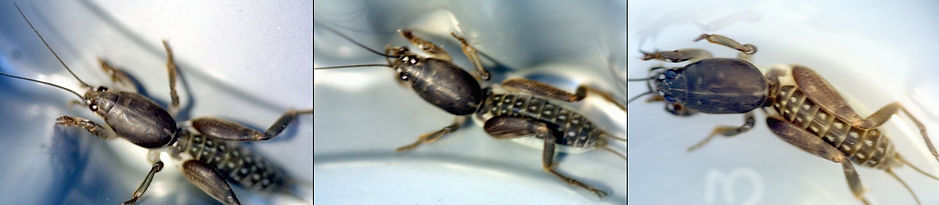
1b Nymphs
Wikipedia: Mole crickets are members of the insect family Gryllotalpidae, in the order Orthoptera (grasshoppers, locusts, and crickets).
https://www.brisbaneinsects.com/brisbane_crickets/Gryllotalpidae.htm
https://www.brisbaneinsects.com/brisbane_crickets/MoleCricket.htm
Mole Crickets have characteristic digging forelegs. Males produce songs and build burrows to amplify their love song. When dug up, they do not leap away like other burrow-inhabiting insects but dig their way back underground with powerful strokes of the forelegs. The dirt is simply forced aside. Their antennae are relatively short.
L
LM
RM
R
2 Katydids
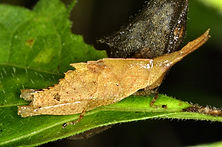
Wikipedia: katydids (aka bush cricket, leaf insect) belong to the suborder Ensifera in the family Tettigoniidae. More than 8,000 species are known, they are nocturnal in habit and may exhibit mimicry or camouflage commonly with shapes and colours similar to leaves.[4]
L 905j201 OZ CRW_2443a thin green leaf katydid
LM
RM
R

SECTION TBD
L 90xjx01 TH IMG_8492a brown leaf mimic
LM
RM
R
Wikipedia: Grasshoppers are a group of insects belonging to the suborder Caelifera.
L 905j301 OZ CRW_0641a
LM 905j302 OZ CRW_0459
RM 905j303 OZ CRW_0630a
R 905j304 OZ CRW_1334


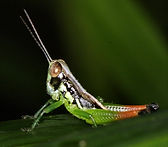

L 905j305 OZ CRW_0959a
LM 905j306 EC xxxxxxa grasshopper eyes in filmholder
M 905j307 OZ CRW_0879a
RM 905j308 OZ Img_9491a
R 905j309 MD IP9S2835j


L
LM
RM
R
L
LM
RM
R
4 Leafhoppers
Wikipedia: a Leafhopper is any species from the infraorder Cicadomorpha within the order Hemiptera. They are are plant feeders that suck plant sap from grass, shrubs, or trees.
Leafhoppers look like tiny, slender cicadas. If you disturb them, they will quickly zip sideways like a crab or jump out of sight. They also excrete a unique waxy substance called brochosomes that they rub all over their bodies to stay dry.
Characteristics: Leafhopper (Family Cicadellidae)
Hind Leg Spines are a long, continuous row of small, uniformly spaced spines along the tibia.
Antennae are attached to the front of the face, directly between the eyes.
Head is generally streamlined, wedge-shaped, or rounded.
Move very quickly; known for moving crab-like (sideways, backwards, and forwards).
Appearance: look like tiny, slender cicadas.
N.B. I'm not an entomologist so I can only guess these are leafhoppers and not planthoppers.
If anybody visits this page and knows different, even better the species names, please let me know!
L 905j401 MD IP9S4540a red yellow blue hopper (may be Graphocephala_coccinea)
M
R

L
LM
RM
R
L
LM
RM
R
5 Planthoppers
Wikipedia: a planthopper is any species in the infraorder Fulgoromorpha in suborder Auchenorrhyncha.
Planthoppers are highly diverse but tend to look more 'tent-like' or resemble small bits of debris or leaves. Famous examples include the invasive spotted lanternfly. If you see a tiny bug with a strange, pointed head or a nymph covered in what looks like white, fuzzy mold, you are looking at a planthopper. [1, 2, 3, 4, 5] They are are plant feeders that suck plant sap from grass, shrubs, or trees.
Characteristics: Planthopper (Superfamily Fulgoroidea)
Hind leg spines are completely absent, or restricted to just a few isolated thick spines.
Attached to the sides of the head, positioned below the eyes.
Head is often exaggerated, elongated, or snout-like.
Move slowly.
Appearance: nymphs often produce fluffy, white waxy filaments to cover themselves.
Planthopper nymphs produce honeydew (liquid sugar) from plant sap and extrude it through specialized glands at the tip of their abdomen which hardens into a wax coating, attracting ants which in turn protect the nymphs from predators and parasites. The tail filaments are made of wax that mimics long antennae and to a predator like a bird or spider, they resemble an insect's head. If a predator strikes the brittle wax sticks they break away harmlessly and the nymph jumps safely away.
905j401 OZ CRW_1417 planthopper nymph mimicking a spider, species unknown (Cairns).
905j402 OZ CRW_1456 planthopper nymph (Cairns), Google AI 2026:
Possibly a planthopper nymph from the family Eurybrachidae (formerly Homoptera), commonly known in Australia as Broad-fronted Planthoppers or Squathoppers [1, 2]. They are commonly found clinging to the trunks and woody stems of native Eucalyptus, Acacia (wattles), or Corymbia trees where they feed on the sap, flattening their mottled bodies against the bark to blend in as a knot or piece of lichen.
L 905j501 OZ CRW_1417 planthopper nymph spider mimic
LM 905j502 OZ CRW_1456a planthopper nymph (Fulgoroid Eurybrachidae)
RM 905j503 OZ CRW_1474a planthopper nymph
R 905j504 OZ CRW_1480a planthopper nymph


L
LM
RM
R
L
LM
RM
R